
It is Tuesday morning at ten o'clock. Nine people join a video call, hit mute, and watch a shared screen while one person reads bullet points off a project board. Task A is complete, task B is blocked waiting for security review, task C will start on Thursday.
For twenty minutes, eight muted participants quietly skim email or scroll news in another browser tab, waiting for their turn to recite three sentences of their own. Nobody asks a question. Nobody changes a decision. The call ends, everyone drops off, and the team returns to the work they paused to attend.
Why do status update meetings feel like a waste of time?
Status update meetings feel unproductive because reading written information aloud is a slow, sequential way to transfer data. When an employee reads progress notes line by line, the entire group moves at the speaker's vocal speed. Readers assimilate text significantly faster than speakers articulate it. When seven people listen to one person speak, six people are idle.
Data from Microsoft's 2023 Work Trend Index showed that workers spent roughly 57 per cent of their time on communication activities, including meetings, chat, and email, leaving 43 per cent for focused creation. When meetings are used primarily to pass basic information around, that communication time yields very little value.
In Atlassian's 2024 report on workplace meetings, knowledge workers judged most of their meetings to be ineffective. Our interpretation is that status update calls account for a large portion of this frustration because they mistake data transmission for collaboration.
What should be written down instead of discussed live?
Progress reporting, KPI measurements, and completed task logs should always be written down asynchronously rather than presented in a live call. If an item requires no immediate group input or negotiation, it belongs in a document, a dashboard, or a brief text update. A bullet point stating that a feature deployed successfully or that weekly signups reached a target number does not benefit from being spoken aloud.
This rule does not apply universally to every meeting context. High-stakes strategic resets, sensitive individual performance feedback, and crisis management require live, synchronous conversation where tone and immediate response matter. However, for routine weekly operations, centralising updates in writing protects focus time for the entire team.
How do you move status updates out of your team meeting?
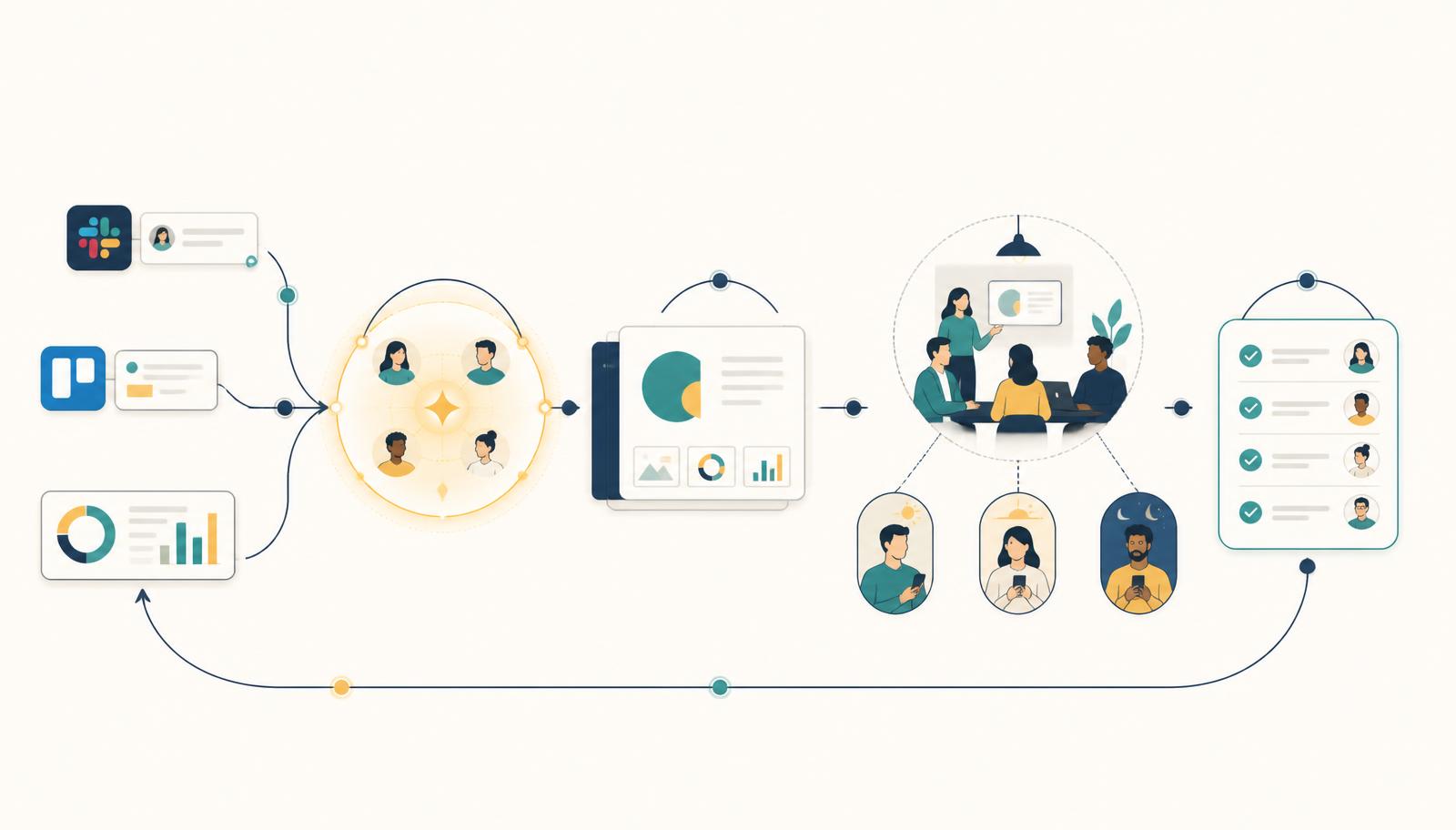
Shifting status updates to written documents requires establishing an asynchronous collection routine prior to the live gathering. On Monday morning, team members receive a prompt to submit brief written summaries of their progress and key metrics. This gives everyone time to read updates before any call takes place.
On Wednesday, the meeting host reviews the submitted updates, spots dependencies or missing figures, and pulls only the unresolved questions onto the live agenda. Curact automates this routine by sending contributors a simple personal link during the week to submit their updates asynchronously, ensuring that routine news stays in writing.
What should actually happen during a live weekly meeting?
Live meeting time should be spent resolving active blockers, debating strategic tradeoffs, and reaching decisions. When written status reports are reviewed beforehand, the live agenda opens with questions rather than speeches. The meeting host asks where team members are stuck, which resources need reallocation, or which competing priorities require alignment.
In Curact, live sessions focus on interactive consensus rather than passive viewing. Teams react directly on shared slides and participate in live scale votes or decision prompts from their phones, keeping everyone engaged throughout the session.
How to audit your status update meeting this Monday
You can separate status reporting from live discussion by applying a simple four-step filter to your current meeting agenda this week.
- 1Label every item on your upcoming agenda as either 'FYI' or 'Decision Required'.
- 2Move all 'FYI' items into a shared weekly document distributed at least 24 hours before the meeting.
- 3Remove any item from the live meeting agenda if nobody has raised a question or blocker regarding it.
- 4Shorten the scheduled call duration by half once passive updates have been removed.
What happens when you stop running status meetings?
Replacing live status calls with written updates gives hours of uninterrupted focus time back to engineering and product teams. Organisational psychologist Steven Rogelberg noted in his 2019 research on meeting science that meeting leaders rate the quality of meetings higher than attendees do. Our interpretation is that leaders often mistake their own active speaking time for team engagement.
When updates are documented asynchronously, quiet contributors gain equal visibility without needing to hold court on camera. The live call becomes shorter, sharper, and noticeably higher in energy.
To transform your weekly operational routine this Monday, cancel the oral update round and ask team members to write two bullet points on progress and one blocker in a shared document 24 hours prior. If you want a simple system that automates update collection and turns written input into interactive live decks, try Curact.
Sources
- Workplace Woes: Meetings Edition — Atlassian (2024)Knowledge workers judge most of their meetings to be ineffective.
- Work Trend Index: Will AI Fix Work? — Microsoft (2023)Most of the working day goes to communicating, not creating.
- The Surprising Science of Meetings — Oxford University Press / Steven G. Rogelberg (2019)Badly run meetings are a leadership skill problem, not a calendar problem.
Findings are paraphrased and linked to the publisher. No source text is reproduced.