
It is 10:00 AM on Tuesday. A new senior software engineer sits in her first cross-team sync between platform engineering and product design. The meeting exists because six months ago, both teams stopped writing down decision records after architecture reviews, preferring instead to explain trade-offs live. Five engineers and three designers spend 45 minutes every week talking through updates that used to live in design briefs.
The team lead has four recurring meetings today and no spare hour to write a bespoke onboarding guide. The plan for the new joiner is straightforward: shadow the weekly sync for three weeks, listen to the team talk, and absorb how the product works. By minute twenty, the new hire is staring at eight silent boxes on a screen while two leads debate an unwritten API boundary. She has no background context, no access to historical decisions, and no clear opening to ask what an internal acronym means.
Using recurring meetings as an informal onboarding engine feels efficient to a busy manager. It requires no advance drafting and creates no extra calendar events. But relying on live verbal syncs to teach new colleagues how a team works creates a quiet tax on everyone in the room.
How much does onboarding a new hire in weekly meetings cost?
When an architectural review is conducted verbally because two teams stopped writing down decision records, an existing engineer and a new joiner enter the call with fundamentally different cognitive baselines. An existing team member holds the unwritten history of past API trade-offs; a new joiner must construct that mental map live.
To calculate the operational cost of this cognitive gap, we separate directly measured inputs from modelled operational assumptions.
Assumed baseline inputs: • Assumed meeting duration: 45 minutes (0.75 hours) • Assumed attendees: 8 existing staff + 1 new joiner = 9 people • Assumed fully loaded hourly cost: £60/hour
Calculated direct cost: 9 attendees × 0.75 hours × £60/hour = £405 per occurrence.
Modelled inputs (Scenarios for unwritten context recovery per attendee outside the meeting): • Scenario A (Low context overhead): Assumed 15 minutes context recovery. Total time = 1.0 hour. Cost per meeting = £540. • Scenario B (Moderate context overhead): Assumed 30 minutes context recovery. Total time = 1.25 hours. Cost per meeting = £675. • Scenario C (High context overhead): Assumed 45 minutes context recovery. Total time = 1.5 hours. Cost per meeting = £810.
If you halve the modelled overhead in Scenario A to an assumed 7.5 minutes per person, the total calculated cost is still £438.75 per meeting. The primary cost is paying eight people to verbally recreate unwritten technical history for one person who still leaves without a written record.
Why do weekly meetings fail as remote onboarding engines?
Weekly syncs fail as onboarding tools when context is delivered as an oral lecture during live meeting time rather than read before the call starts.
Microsoft's 2023 Work Trend Index found that workers spend around 57% of their time in communication tools such as meetings, email, and chat, leaving only 43% for focused creation. We think that when a team stops writing down decisions, the meeting becomes the only place where institutional memory lives, forcing a new joiner to piece together product architecture from fragmented verbal remarks.
Gallup's 2024 workplace research consistently links employee engagement to clear expectations and regular, meaningful contact with the team. We think a recurring meeting should provide that contact, but when the meeting is unstructured, our interpretation is that a new joiner receives neither clear expectations nor meaningful context.
Organisational psychologist Steven Rogelberg's 2019 research on meeting science indicates that meeting leaders systematically overrate the quality of the meetings they run. We think this explains why a team lead might assume a new hire is picking up valuable nuance during a live debate, while in reality the new hire feels hesitant to interrupt eight colleagues to ask basic structural questions.
This advice does not hold for every meeting type. For high-stakes incident post-mortems or initial team bonding sessions, live, real-time verbal discussion is essential. But for routine weekly syncs, using live synchronous time to read updates aloud to a new employee is inefficient.
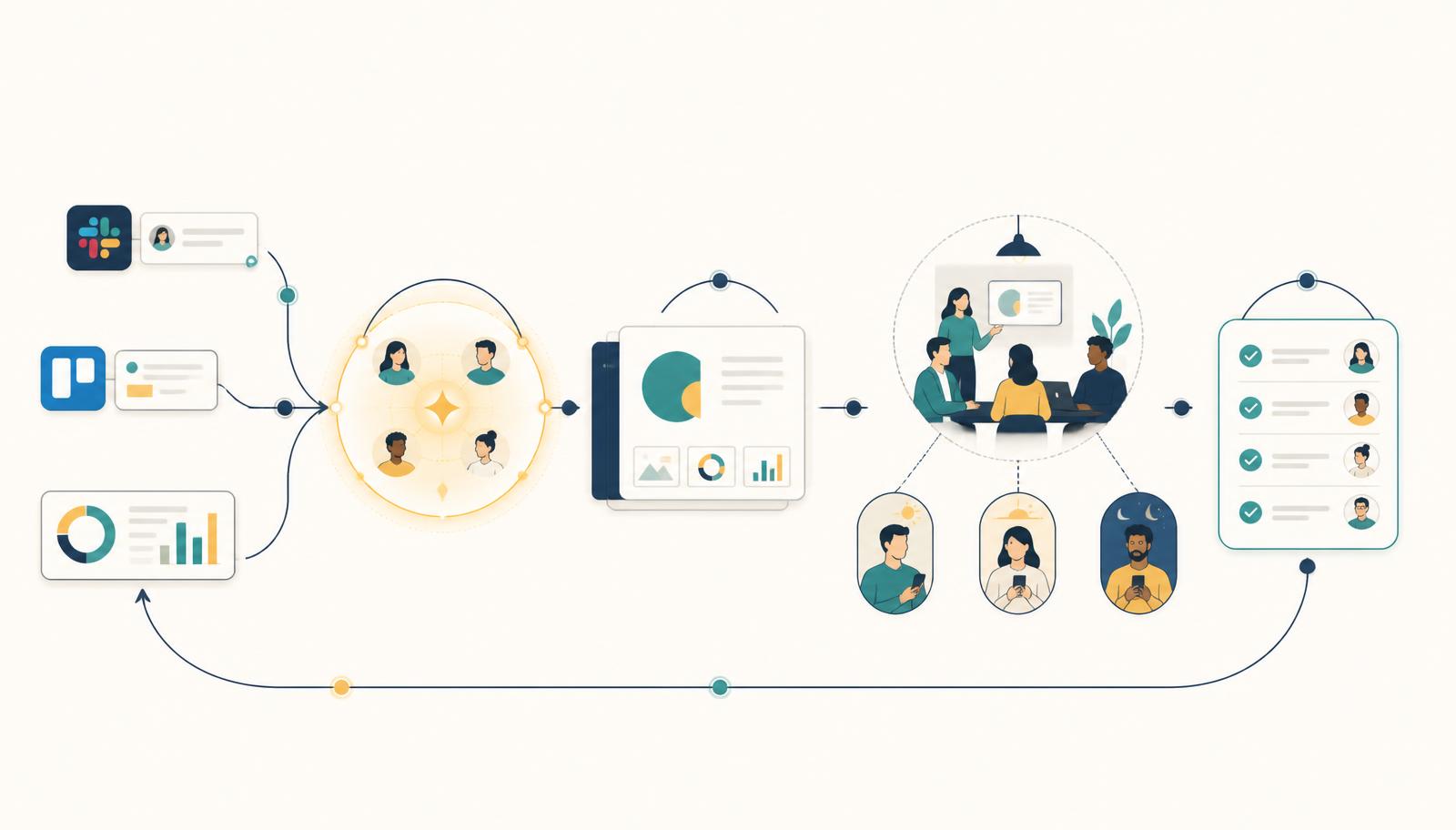
How to distribute meeting preparation so new hires learn asynchronously
For routine operational syncs, structuring meeting preparation across the week allows new hires to absorb background context and historical decisions before sitting down in the live call.
Instead of forcing a new colleague to figure out ongoing projects during live discussion, move the information gathering to the days before the meeting.
Here is how a distributed preparation rhythm works across a typical week for operational syncs:
• Monday: Standing content for the weekly series (ongoing project trackers, key design updates, and architectural decisions) populates automatically in the series workspace. • Tuesday: Team members receive personal preparation requests via Slack. We recommend each contributor spend an assumed five minutes writing down their progress, linking to relevant specification docs or tickets, and identifying active blockers. • Wednesday Morning: The new joiner opens the review deck. Because updates are written down in structured slides, she can click through background links, read recent decision rationale, and leave questions asynchronously. • Wednesday Afternoon: The team joins an assumed 30-minute live session. Because status updates were read in advance, the live call is dedicated entirely to discussing the specific trade-offs that require group debate.
In Curact, this cadence is built directly into the recurring series. Standing blocks pull context automatically, while individual contributor links prompt engineers and designers to submit their input before the call. The new joiner reads the prepared deck ahead of time, turning the live meeting into a place for target clarification rather than baseline education.
How to turn your next weekly meeting into an onboarding asset on Monday
You can make your next recurring operational meeting instantly accessible to a new joiner by adding an assumed five-minute pre-meeting context check to your written agenda. While this approach is less effective for unstructured brainstorming or delicate personal one-on-ones, it works well for recurring team syncs.
If you have a new colleague starting next week and no time to draft formal documentation, apply this simple three-step structure to your existing sync on Monday:
1. Attach context links to agenda items a recommended 24 hours prior. Require anyone adding a topic to the meeting agenda to include a link to the underlying task, design file, or brief. We recommend deferring unlinked items to the following week. 2. Assign an onboarding meeting buddy. Pair the new hire with an existing team member. We suggest spending a recommended three minutes on Slack before the call highlighting the single most important decision on the agenda so the new hire knows where to focus. 3. Allocate an assumed first five minutes to silent reading. If contributors have not written updates in advance, open the meeting with five minutes of silent reading of the shared agenda notes. This gives the new joiner equal ground to digest updates before verbal discussion begins.
Give your next new hire the written background context a recommended 24 hours before your weekly sync, and reserve the live call exclusively for active discussion.
If you want to automate meeting preparation and turn your recurring syncs into structured context hubs, Curact makes it simple to run distributed meetings every week.
Sources
- Work Trend Index: Will AI Fix Work? — Microsoft (2023)Most of the working day goes to communicating, not creating.
- The Surprising Science of Meetings — Oxford University Press / Steven G. Rogelberg (2019)Badly run meetings are a leadership skill problem, not a calendar problem.
- State of the Global Workplace — Gallup (2024)Remote and hybrid employees need deliberate rhythm to stay connected.
Findings are paraphrased and linked to the publisher. No source text is reproduced.