Your team builds the meeting. Agents do the legwork.
One person shouldn't write the agenda the night before, half the company shouldn't sit silent in another timezone, and what you decide shouldn't disappear the moment the call ends. Curact fixes all three — one meeting, or a series that gets better every round.
And a meeting here isn't necessarily an hour in a calendar. It's a shared surface that lives for days: some run as a live session, some never meet at all.
Curate. Participate. Act.
30 days, no card, cancel in one click. Your first meeting can be up in minutes.
- Built by Textalk
- Used for our own weekly start
- Connects to Slack — works alongside Teams, Zoom and Meet
- Data stays in the EU
Sound familiar?
Preparation
The agenda is written the night before, by the same person — and nobody has time to dig through Slack and the boards for what actually mattered this week.
Preparation
The people with something to say are never the ones asked to present, and nobody knows which teams haven't been heard in six months.
Participation
Half the company is in another timezone or in a customer call. They get a recording nobody watches.
Follow-through
The meeting ends, the notes are filed, and everything is exactly as before.
How it works
You don't build the meeting alone
Every other tool optimises for holding the hour. The value lives in what happens around it — before, during and after.
Which is why the call is optional. Run a meeting fully async with no session at all, keep a short call with the prep and the follow-up done around it, or hold the classic hour — only with everyone actually taking part.
What we mean by a meeting
A deck anyone can contribute to, a room people join from their phone without an account, and a decision log that carries between rounds. The call is one way to use it. The participation is the point.
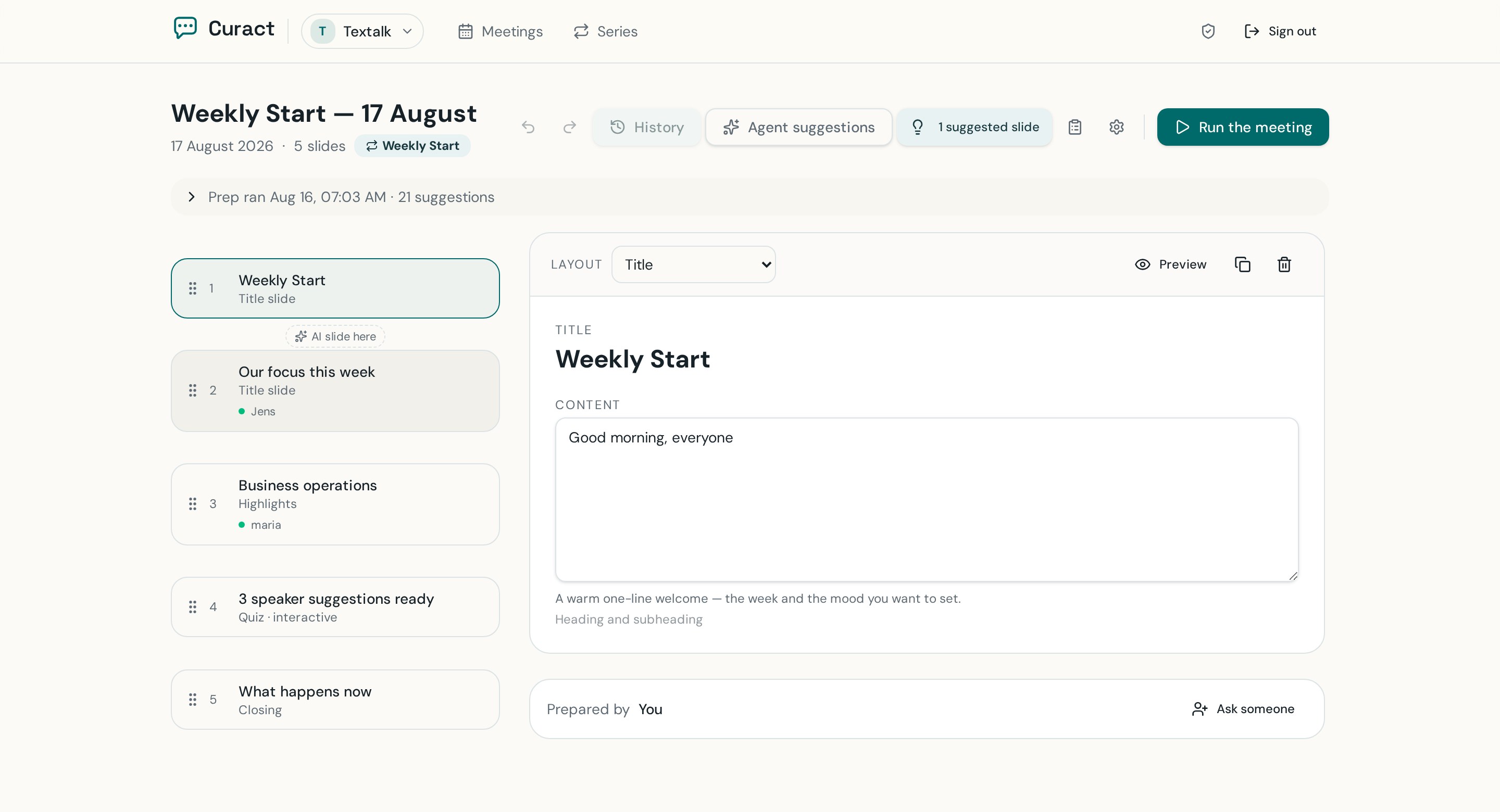
- BeforeThe agenda is filled by the people who know.Agents read the Slack channels, boards and numbers you point them at and draft the slide. The right person gets a link with a ready-made block to fill in, and a nudge if it's still empty. Ask everyone for a few words and a picture, and each reply becomes its own slide once you approve it.Step 1
- DuringEveryone takes part, wherever they are.A live view with speaker handover and a timer on your screen. Everyone else joins from their phone with a code — no account, no install — for polls, quizzes, scales, word clouds, questions to and from the room, reactions and team scores.Step 2
- AfterIt doesn't go back to normal.A readable recap, and decisions with a name and a deadline. Follow-ups belong to the series rather than one meeting's notes, so they come back with their status next time — or land in the task tool you already use.Step 3
Meeting types
Built for the meetings you actually run
Same mechanics, different shape. Some of these are best as a short live hour, some work better with no call at all — you decide per meeting, not per tool.
Product development
Sprint reviews where the status reading takes the hour the decisions needed.
Squads write their own slides during the week and agents draft from Slack and your boards, so the call starts on the open questions.
Read moreSales
A pipeline spreadsheet read out loud while the confident rep gets the airtime.
Reps write their own pages before the meeting and KPI owners are nudged for a fresh figure, so the call is coaching, not reporting.
Read moreCustomer feedback
One loud anecdote beats the pattern, and nothing becomes work afterwards.
Everyone who talks to customers writes their themes on a link beforehand, and each agreed fix leaves with a named owner.
Read moreAll-hands / town hall
A broadcast at an hour that half the company is asleep for.
Questions asked and upvoted before the meeting, teams writing their own spotlight, and the deck readable afterwards for every time zone.
Read moreKPI & business review
A deck rebuilt by hand every month, with half the numbers already stale.
Each number has an owner who is asked for a fresh figure, last period carries over, and follow-ups come back with a status.
Read moreProject kickoff
Scope in one person's head and decisions nobody wrote down.
Goal, scope, milestones and risks written by their owners in advance, and every open decision leaving with a name and a date.
Read moreRetro / check-in
The same three people speak; the quiet feedback never surfaces.
Anonymous 1–5 scales and word clouds answered from a phone, so the honest signal is on the screen before the discussion starts.
Read moreWorkshop / brainstorm
Ideas on a whiteboard that stays on the whiteboard.
Contributions collected on a link days ahead, prioritised by a live vote from everyone's phone, and turned into follow-ups with owners.
Read moreOnboarding / welcome
A calendar invite and a hope that someone does the intro.
A repeatable welcome deck: who's who, an icebreaker from phones, and a page the new colleague writes themselves before day one.
Read moreCulture & social
Remote teams that never talk about anything but work.
Highlights, photos and this-or-that rounds collected async, shown as two minutes at the top of a meeting you already have.
Read moreQuiz / game
A separate polling tool, a separate deck, a separate scoreboard.
Quiz slides, teams and a leaderboard live in the same deck, answered from everyone's phone.
Read moreEvery type starts from a ready-made deck you can rewrite, reorder or throw away. Nothing is locked to a format. Compare all meeting types.
Meet the agents
Nobody has to dig through Slack the night before
An agent is a small, focused worker you switch on. It reads the sources you connect, drafts the slide and asks the person who knows.
- It finds something
- It drafts the slide
- It asks the right person
- You approve
From what you already have
Reads the conversations, boards and numbers inside the company.
Signal scout
Reads the Slack channels and Trello boards you point it at, and picks out what's worth telling the whole company.
Speaker recruiter
Asks the right person in Slack for a short slot, with a ready-made block to fill in — and nudges them if it's still empty.
KPI watcher
Checks every key number, nudges its owner for a fresh value and drafts one slide per KPI.
Team spotlight
Invites the team that's waited longest to tell everyone what they're working on.
From the outside world
Searches the open web. One focus per agent keeps the findings sharp.
- Competitors
- Market & technology
- Regulation & policy
- Customers & industry
From the systems you run
CRM, support desk and billing, read for the period and turned into slides.
- New business
- In negotiation
- Support pulse
- Revenue snapshot
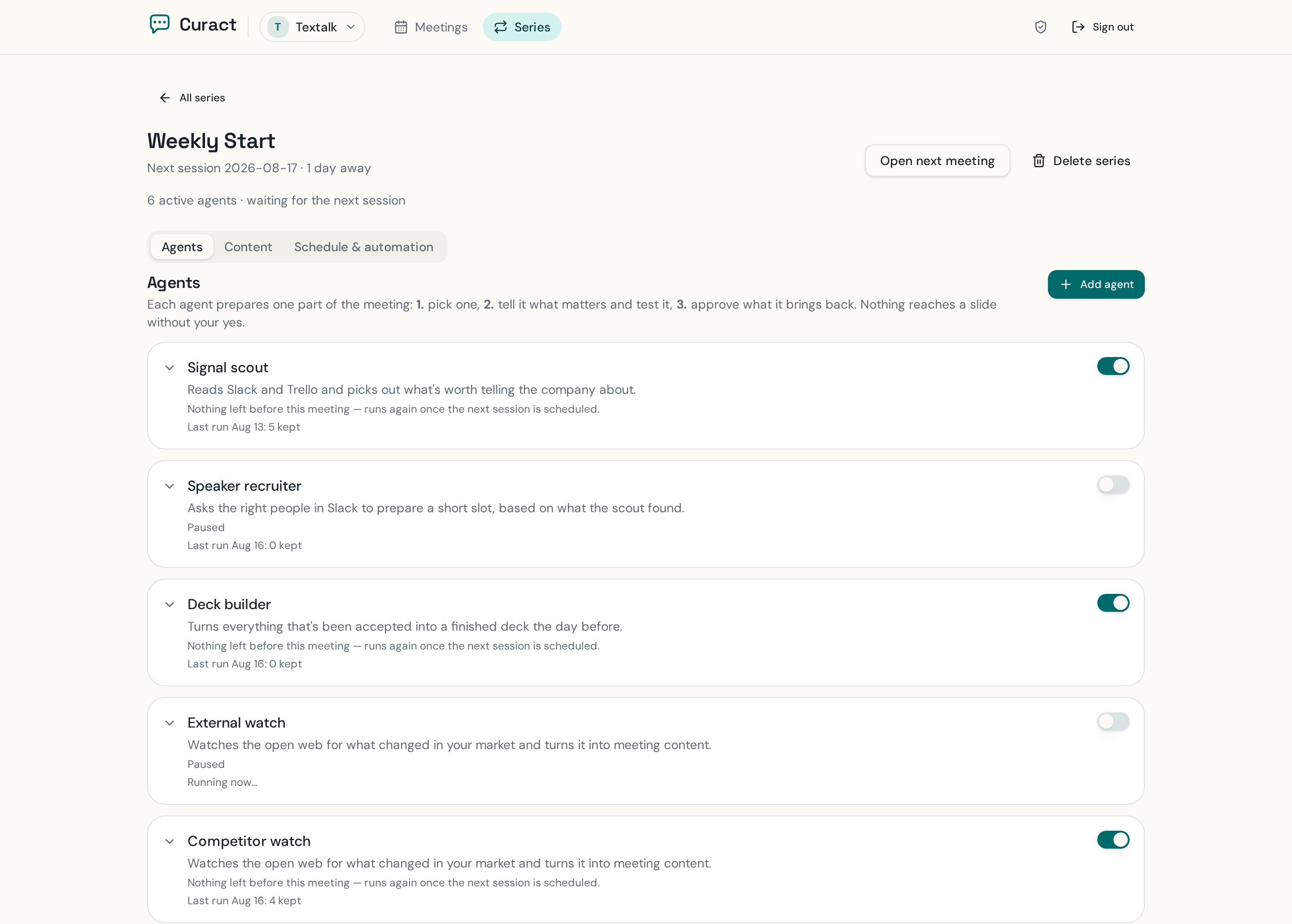
Agents propose, people approve
Nothing is posted or shown to the company without a person saying yes. You choose the sources, sensitive content is filtered out, and every run is logged.
You decide how much it brings
A precision dial runs from "only the big things" to "show me everything", and what you dismiss teaches the agent what not to bring next time.
30 days, no card, cancel in one click.
Works with your stack
It fits around the tools you already have
You keep the conversation, the calendar and the task tool. Curact replaces the two things that waste the hour: the hand-built deck, and the one-off poll nobody remembers.
Connected
Slack
Curact reads the channels you choose, sends the right person a DM with a block to fill in, and posts the recap when the meeting is over.
Connected
Trello
Reads the boards you point it at to spot work worth raising, and turns follow-ups into cards with an owner.
Keep it
Microsoft Teams
Keep it for the call itself. Curact runs the deck and the participation inside the hour, and shares the live view on your screen.
Keep it
Zoom & Google Meet
Keep the call. Share the live view; everyone else joins from their phone with a code — no account, no install.
Replaced
Google Slides & PowerPoint
The deck stops being built by hand the night before. It's assembled from real activity, and the right person writes their own page.
Replaced
Mentimeter & Slido
Polls, quizzes, scales and word clouds aren't a second tool you switch to — they're slide types in the same deck.
Notifications, speaker requests and recaps are delivered over Slack or email. Everything else — the video call, the calendar invite, the board where the work lives — stays exactly where it is.
Getting started
Up and running in three steps
- 12 minutes
Connect a source
Point Curact at a Slack channel, a Trello board or a KPI you track. Nothing else has to move.
- 21 minute
Switch on an agent
Pick one from the gallery, say what you care about in plain language, set the precision dial.
- 3Same day
Approve the first slide
The agent brings a suggestion with the source attached. Approve it and it's on the agenda.
30 days, no card, cancel in one click.
Pricing
Free for 30 days. Then 124 kr a month per facilitator, billed yearly.
A facilitator creates meetings and series, decides who prepares what, and approves the content. Everyone else joins with a link — free, unlimited, and they can still contribute slides, answers and comments.
Starter
Everything in the product, for the team that runs the weekly kickoff for real.
124 krper facilitator, per month
Billed annually — 1490 kr per facilitator per year, two months free
373 kr / month · 4470 kr billed yearly
Contributors and participants are free — room size is the only thing that grows with the crowd
No card needed to start
- Unlimited meetings and series, unlimited free contributors and participants
- Live view, mobile join, polls, word clouds, reactions and questions
- Connected systems: Slack, Teams, Trello
- Prep agents: Signal Scout, Deck Builder, Speaker Recruiter
- Slide owners invited over Slack or email, with automatic reminders
- Focus areas, team spotlight rotation, KPIs per series
- Recaps, follow-ups and full archive history
Scale
For several companies, departments or communities under one roof.
Custom
Priced to your setup, billed yearly
Unlimited facilitators
Automation allowance sized to your organisation
- Everything in Starter, plus
- Several companies, departments or communities in one workspace
- Your own sources via JSON or API, unlimited connections
- Your own agent instructions per series and focus area
- PII rules and approval flows before anything reaches the deck
- Roles, multiple workspaces and SSO
- Priority support and onboarding
What you pay for, in plain words
Facilitators run the meetings and series: they build the deck, hand slides to people, approve what goes in and follow up afterwards. Everyone else gets a link, writes their slide, votes, asks and comments — free, however many they are. Room size is the only thing that follows the size of your crowd, because a live room of 2 000 costs us real traffic.
Each workspace also has an automation allowance — agent runs, indexed messages and AI summaries — that grows with the number of facilitators. Reach it and automation pauses until the next period. Nothing breaks, nothing is silently billed.
- A person approves before anything reaches the deck
- Sensitive content is filtered out before indexing
- Every agent run is logged and reviewable
- One invoice a year, no surprise charges
All prices are in SEK excluding VAT. Curact is sold and invoiced by Textalk AB, Sweden. Swedish VAT is added for Swedish customers; EU businesses with a valid VAT number are invoiced under reverse charge, and customers outside the EU are invoiced without EU VAT.
Honest questions
The things people ask before they change anything
Time well spent — for everyone in the room, and everyone who couldn't be there.
Start with one meeting. Turn it into a series when it earns its place. Free for 30 days, no card.