
The presentation is finished, but nobody is speaking
You sit in gallery view while four department heads read thirty slides of key performance indicators. People have their cameras on, nodding at regular intervals while their eyes track Slack messages on a second monitor. You are the reluctantly assigned facilitator, holding the slide deck controls, wondering why three days of chasing updates yielded zero questions in the chat.
An all-hands meeting easily degrades into a televised broadcast. When one person builds the deck and coordinates the presenters, everyone else adopts the posture of an audience. Changing the slide template or adding energetic icebreakers does not alter this dynamic, because the structure itself demands passive consumption.
Why do all-hands meetings turn into one-way broadcasts?
All-hands meetings become broadcasts because preparation is concentrated in a single host who collects updates instead of requiring team leads to contribute directly before the session. When information is gathered asynchronously by one person, the live meeting becomes the first time anyone else sees the figures, turning the call into a reading exercise.
Research published in Steven G. Rogelberg's 2019 study, The Surprising Science of Meetings, indicates that meeting leaders systematically evaluate the effectiveness of their meetings more positively than attendees do. Our interpretation is that facilitators confuse the effort spent assembling slides with genuine engagement from the room.
This dynamic holds true primarily for operational updates, team syncs, and recurring company updates. It does not apply to crisis management or major structural announcements, where a clear, one-way broadcast is precisely what the organisation requires.
How to distribute all-hands preparation across the week
To shift an all-hands meeting from a broadcast to a working session, separate the collection of updates from the live discussion using this weekly cadence:
- 1Monday morning: Define the structure. The host sets up standing blocks for the upcoming meeting—such as key metrics, department wins, and strategic risks—without filling in the answers.
- 2Wednesday morning: Prompt department contributors. Send specific input requests to department leads. Systems like Curact handle this by issuing personal contributor links directly to each lead, allowing them to submit updates, context, and numbers from their phone or browser without editing a master deck.
- 3Thursday afternoon: Review and compile. The host reviews submitted entries in a single inbox, approving figures or requesting clarification before the live view is finalised.
- 4Friday morning: Focus the live meeting on decisions. Instead of reading slides aloud, spend the synchronous time discussing metrics that missed target or trade-offs that require cross-department alignment.
How do you make numbers interactive instead of reading them out loud?
You make numbers interactive by publishing the KPI register ahead of time and using synchronous time solely to query discrepancies. Reading figures aloud on a call forces attendees to process raw data in real time, which leaves no cognitive room for critical thinking.
In Atlassian's 2024 study, Workplace Woes: Meetings Edition, knowledge workers reported judging most of their meetings to be ineffective. When an all-hands meeting consists of executive staff reading spreadsheet rows aloud, it exemplifies this inefficiency.
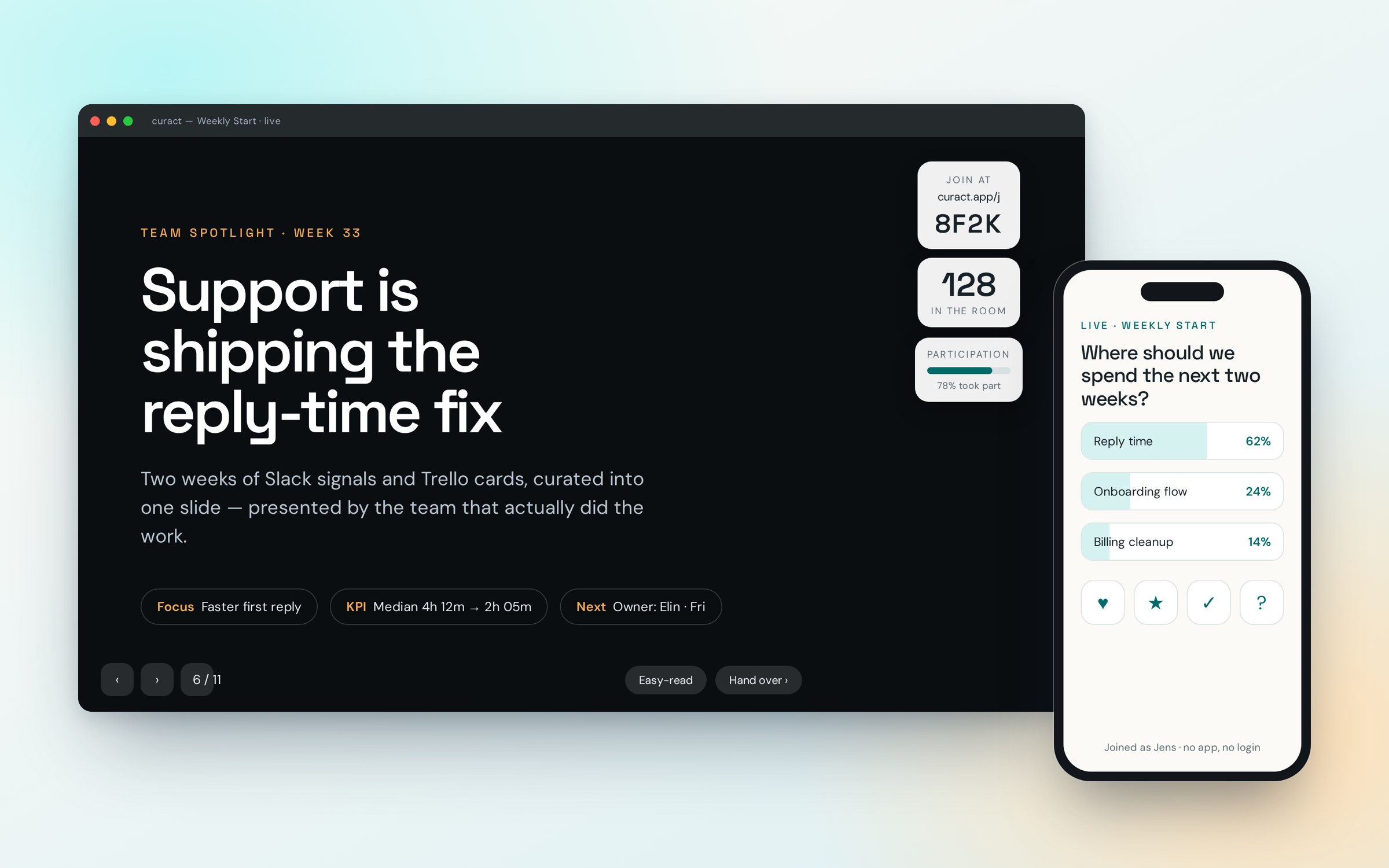
When running the live meeting in Curact, participants join from their phones using a simple code or QR scan to answer live prompts on the shared screen. Asking 'Which of these three department metrics poses the highest risk to our quarterly goal?' produces immediate live data that shifts the meeting directly into debate.
Four signs your all-hands meeting is slipping back into a broadcast
Watch for these early indicators that your meeting structure is returning to a passive presentation:
- •Slide hoarding: Department leads submit dense text slides right before the start time, indicating that updates were compiled under pressure rather than prepared thoughtfully.
- •Chat silence: The main chat remains empty throughout the call except for polite applause emojis when major milestones are announced.
- •Facilitator dominance: The facilitator or executive speaks for the vast majority of the scheduled duration, turning discussion prompts back into personal commentary.
- •Unread metrics: Team members ask basic clarifying questions during the call that were explicitly answered in the pre-read material.
A practical framework you can test this Monday
To fix your next all-hands meeting without changing your software stack immediately, implement a pre-meeting reading window and a single forcing question.
We recommend sending out your executive update document or slide deck 24 hours in advance with a hard rule: no speaker will present their slides during the call. Inform attendees that the first five minutes of the meeting will be silent reading time for anyone who has not reviewed the material.
Open the discussion phase by asking one explicit trade-off question: 'Based on the sales numbers submitted in section two, where should we reallocate engineering focus next month?' This forces attendees to apply the data rather than merely listen to it.
If you want a structured platform that automates contributor collection, live phone participation, and post-meeting recaps, try Curact for your next recurring meeting series.
Sources
- Workplace Woes: Meetings Edition — Atlassian (2024)Knowledge workers judge most of their meetings to be ineffective.
- The Surprising Science of Meetings — Oxford University Press / Steven G. Rogelberg (2019)Badly run meetings are a leadership skill problem, not a calendar problem.
Findings are paraphrased and linked to the publisher. No source text is reproduced.