
It is 10:02 on Tuesday morning. A shared screen flickers on, revealing a complex spreadsheet with multiple tabs and distinct colour-coding systems. The meeting host filters by date, scrolls down through the rows, and clicks on an unformatted cell to check why qualified leads dropped last week.
A team of colleagues watches the cursor jump between cells in real time. Nobody knows why the lead count changed because the person responsible for top-of-funnel marketing is still trying to locate the correct dashboard tab. Minutes pass in quiet, uncomfortable monitoring while one person extracts figures live on video.
This is spreadsheet archaeology. It happens when a weekly KPI review meeting relies on live discovery rather than pre-meeting preparation. When nobody owns the numbers before the call starts, the call becomes an expensive data-retrieval exercise.
Why do weekly KPI review meetings turn into spreadsheet archaeology?
Weekly KPI review meetings turn into spreadsheet archaeology when preparation responsibility falls entirely on the meeting host or on no one at all. When a single manager is expected to collect, verify, and present every metric, team members arrive as passive spectators rather than active owners.
In his 2019 research published in The Surprising Science of Meetings, organisational psychologist Steven Rogelberg noted that meeting leaders consistently rate the quality of their own meetings higher than attendees do. We think this gap expands in metric reviews because hosts mistake the effort of navigating dashboards for productive team engagement.
When attendees are not required to submit narrative context before the meeting, they default to reading figures off the screen as they appear. A raw number without context yields vague guesses during the call, pushing actual analysis into follow-up messages later in the week.
Who should own the numbers in a recurring KPI review?
Every metric on a weekly dashboard requires exactly one named owner who is responsible for providing context before the team meets. Dual ownership or unassigned metrics often mean that no one checks the underlying data until someone shares a screen.
The owner of a metric is not necessarily the person who enters the raw data into a database. The metric owner is the team member closest to the operational work behind the number. For instance, the head of outbound sales owns response rate, while the customer success lead owns net expansion.
Assigning explicit ownership changes the psychological contract of the meeting. Instead of answering sudden questions about an unfamiliar spreadsheet cell on Tuesday, the metric owner adds a brief written comment on Monday explaining what changed and why.
How to structure a weekly KPI review step by step
A functioning KPI review distributes preparation across the week so that the live call stays brief and decision-focused.
Follow this weekly operational cadence to move from live data fetching to asynchronous preparation:
- 1Friday afternoon: Automated reminders or system prompts notify each metric owner to inspect their numbers for the past week.
- 2Monday morning: Metric owners submit a brief written commentary for any key indicator that diverged by more than five percent from target.
- 3Monday afternoon: The host reviews submitted comments, approving entries into the central deck and flagging only red or off-track KPIs for live debate.
- 4Tuesday morning: The team conducts a twenty-minute live review focused exclusively on off-track metrics and agreed intervention plans.
- 5Tuesday afternoon: Key decisions and action items generated during the discussion are dispatched to owners as clear follow-up tasks.
When does structured KPI preparation fail?
Structured asynchronous preparation works exceptionally well for recurring operational meetings like weekly department syncs, executive staff calls, and revenue reviews. It fails when applied to open-ended strategic explorations where metrics are not yet established.
If a team is attempting to define new performance measures during an initial project kickoff, forcing people into rigid slide submissions before the meeting creates unnecessary friction. Early-stage discovery requires blank whiteboards, fluid debate, and speculative thinking.
Standardised KPI preparation also falters if leadership demands exhaustive essays for every minor variance. Context notes should remain brief: two or three sentences identifying the cause of a shift and the immediate remedial action being taken.
How much does unprepared KPI hunting actually cost?
The direct financial cost of an unprepared metric review can be calculated using meeting duration, attendee count, and loaded hourly compensation.
Consider an eight-person operational review that runs for 45 minutes every week. Assuming a fully loaded hourly cost of £65 per attendee across engineering, product, and marketing, the basic payroll cost of the call itself is £390 per week, or £19,500 over a 50-week working year.
Now model the time allocation within that call. If 20 minutes of each 45-minute session are spent watching a host open tabs, refresh reports, and explain row definitions, £173 of payroll per meeting is absorbed purely by context retrieval. Over 50 weeks, that scenario spend totals £8,650 on spreadsheet navigation alone, before accounting for context switching or displaced work.
How an automated workflow replaces spreadsheet hunting
An automated preparation workflow addresses live spreadsheet archaeology by turning the weekly KPI review into a predictable async-to-live process. Rather than forcing one host to copy numbers into slides, a structured platform manages a recurring KPI register where individual owners receive targeted requests during the week.
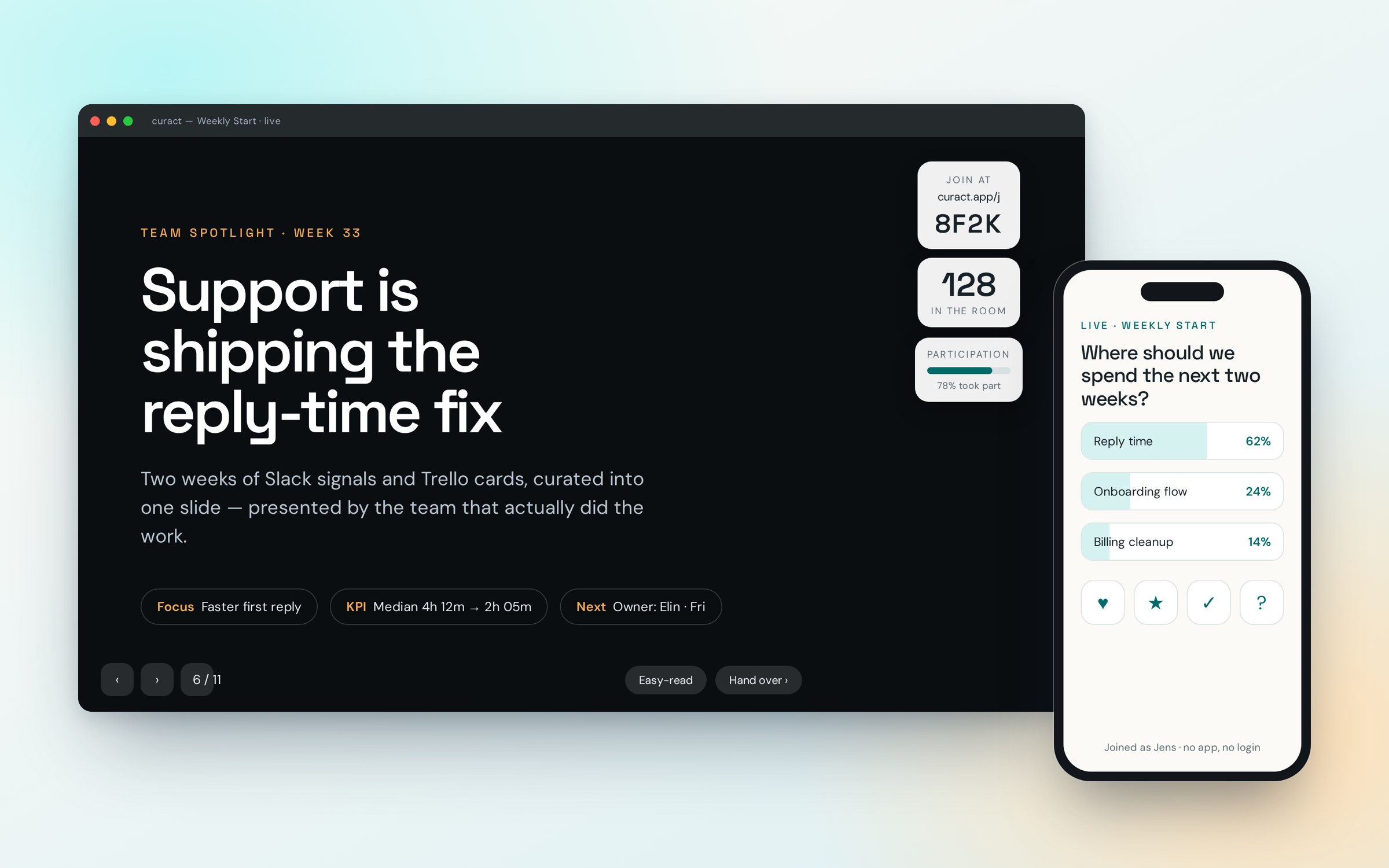
Metric owners get a lightweight preparation link directly in Slack or email, allowing them to confirm figures and add written comments from their laptop or phone without logging into full reporting suites. In Curact, the host reviews incoming metric updates in a single inbox, approving clear context slides into the meeting deck with a single click.
During the live session, participants join from their phones using a simple code, while the presentation advances on the main screen. When an off-track metric appears, the team spends meeting time reviewing the owner's written assessment and logging concrete follow-up tasks, rather than searching for raw data.
How to fix your KPI review meeting on Monday
To stop spreadsheet archaeology on Monday, assign every single KPI on your dashboard to one named owner today. Send a simple instruction: if their number moved by more than five percent this week, they must post a two-sentence explanation in your team channel twenty-four hours before the call.
During the next meeting, lock the raw spreadsheet tab. Share only the slide deck or document containing the prepared explanations, and skip green or on-track metrics entirely to concentrate on unresolved challenges.
If you want an automated system that collects metric updates from owners, builds review decks cleanly, and turns meeting decisions into clear follow-up tasks, consider Curact.
Sources
- Workplace Woes: Meetings Edition — Atlassian (2024)Knowledge workers judge most of their meetings to be ineffective.
- Work Trend Index: Will AI Fix Work? — Microsoft (2023)Most of the working day goes to communicating, not creating.
- The Surprising Science of Meetings — Oxford University Press / Steven G. Rogelberg (2019)Badly run meetings are a leadership skill problem, not a calendar problem.
Findings are paraphrased and linked to the publisher. No source text is reproduced.