
Tuesday morning, 09:15. The head of operations reaches slide four of the monthly leadership review and reads six columns of margin figures line by line. Everyone on the call is looking at the same spreadsheet grid. At the bottom of the table, one regional figure is three percentage points below budget. The facilitator pauses, looks at the grid of webcams, and asks the familiar question: "Does anyone have any thoughts or questions on these numbers?"
Silence. Two people adjust their microphones, one person nods slowly, and after four seconds, the senior vice president fills the vacuum with a general comment about Q3 market pressures. The meeting moves on. The two leads in the room who noticed the inventory anomaly three minutes earlier say nothing, because jumping into an open verbal gap feels like interrupting.
Why does open-floor discussion exclude quiet team members?
Open-floor discussion excludes quiet team members because it rewards immediate verbal speed over deliberate analysis.
When teams operate across timezones, forcing silent live writing during a call creates a distinct bottleneck: team members working at the end of their day or reading in a second language are forced to scan data and write under live clock pressure. Submitting written context asynchronously before the call alters how distributed teams handle silent reading. When financial or operational notes arrive ahead of time, attendees consume the context on their own schedule rather than spending live call minutes scanning spreadsheets. During the meeting, silent reading shifts from initial context ingestion to evaluating explicit trade-offs and responding to already-formulated written perspectives.
In a remote leadership meeting reviewing numerical updates, open-floor discussion fails. Processing complex operational numbers requires cognitive time. When data is presented verbally and followed immediately by an open invitation to comment, the conversation naturally defaults to those who think out loud. In his 2019 book The Surprising Science of Meetings, organizational psychologist Steven Rogelberg noted that meeting leaders consistently rate the quality of their meetings higher than attendees do. We think this gap opens up because leaders interpret silence as agreement when attendees are simply disengaged or waiting for space.
The quiet contributor is rarely disengaged. They are usually evaluating trade-offs, checking figures against last week's report, or waiting for a natural pause that never arrives over a video link. When the only mechanism for participation is interrupting a senior colleague, quiet expertise stays on mute.
How can silent input change team participation?
Silent written input levels the floor by giving every participant the same time and medium to respond before verbal debate begins.
To change who contributes, the structure of the meeting must separate data ingestion from opinion gathering. When numbers are read out loud during live meeting time, participants spend their cognitive energy listening rather than thinking.
Instead of asking for verbal commentary after reading numbers, we recommend giving the room two minutes of silence with a specific written prompt. Ask a single, direct question: "Which figure on this grid carries the highest operational risk for next month?" or "What assumption behind this forecast seems least realistic?"
When everyone writes their response simultaneously before anyone speaks out loud, three structural shifts occur. First, senior executives cannot anchor the room's consensus with an early remark. Second, quiet participants complete their thoughts without having to compete for airtime. Third, the facilitator receives a clear map of what the entire room actually thinks, rather than relying on the opinions of the person most comfortable talking over a microphone.
How to run an inclusive meeting on Monday without new software
You can make your next leadership review significantly more inclusive on Monday by making three adjustments to your existing agenda.
First, we recommend sending the KPI table or operational update 24 hours before the call with a five-minute silent pre-read block built directly into the calendar invite. Explicitly state that figures will not be read out loud during the meeting.
Second, replace the open phrase "Any comments?" with a structured written prompt. In your shared document or meeting chat, ask each functional lead to type one observation and one risk before anyone opens their microphone. We suggest giving the room ninety seconds of quiet typing time.
Third, call on participants based on what they wrote rather than who spoke first. Read through the typed inputs and invite the author of an unexpected point to expand on it verbally. This transforms the facilitator's role from managing awkward silences into curating insights that have already been expressed in writing.
How structured meeting series keep preparation and participation balanced
Structured meeting series ensure that silent contribution begins days before the live call takes place.
For recurring reviews where numbers and operational metrics repeat every week, managing written prompts manually in shared documents can create administrative drag for the meeting host. This is where a dedicated meeting platform like Curact changes the mechanics.
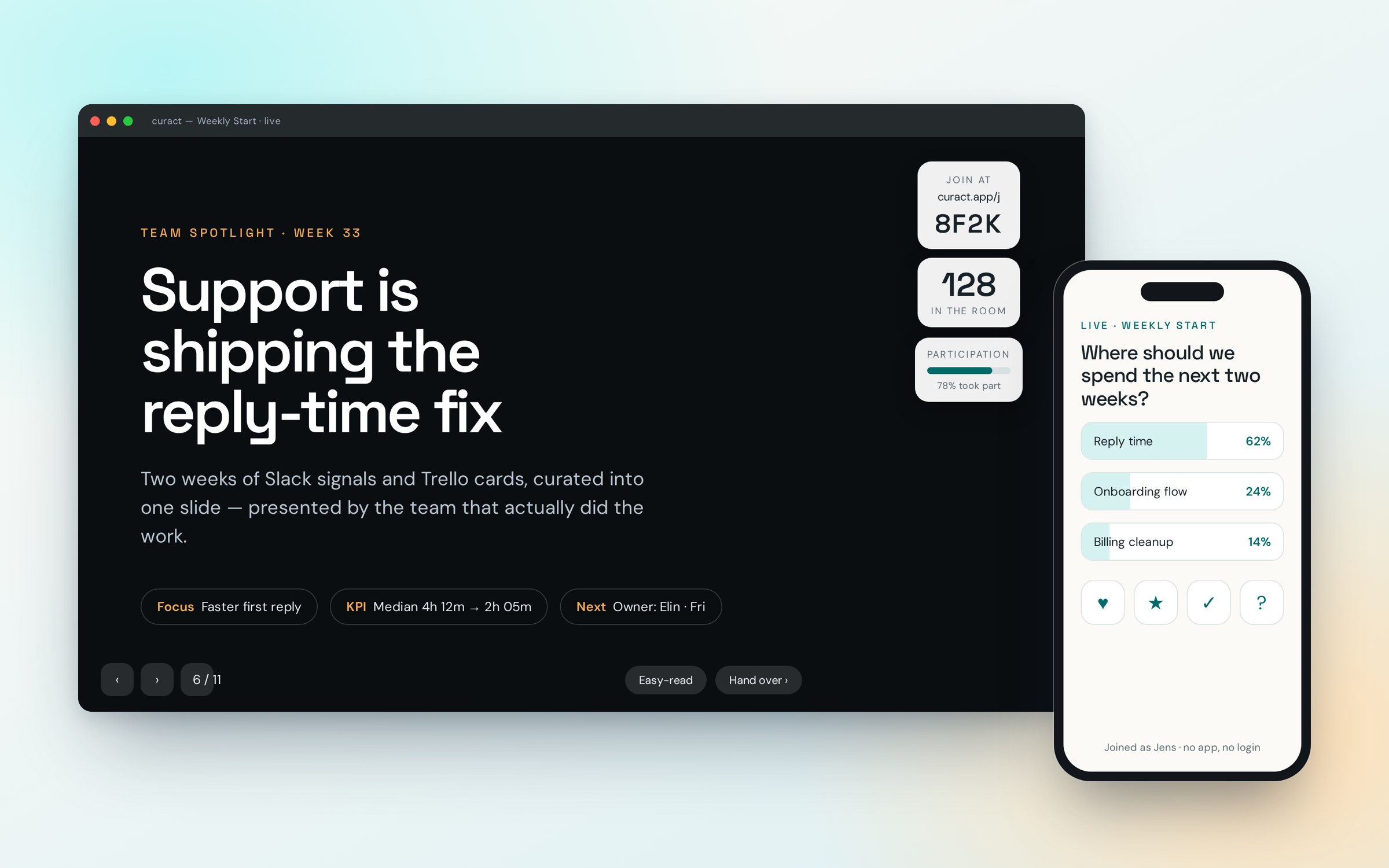
In Curact, a recurring leadership review is set up as a series rather than a sequence of disconnected calendar invites. Standing content like KPI registers and team updates live on the series, so contributors receive individual prompts to submit their figures and written context asynchronously during the week. When the meeting starts, participants join the live view on a shared screen and respond to structured prompts, scale polls, or word clouds directly from their phones without needing an app or login.
Because input is collected silently in real time, the entire team participates at once without needing to interject. The facilitator can see consensus and disagreement instantly on screen, leaving the rest of the live session available for making decisions. Decisions reached during the call are recorded directly with an owner and a due date, ensuring follow-ups carry naturally into the next cycle.
Where does structured silent input not work?
Structured silent input is designed for analytical and decision-heavy reviews, not for every gathering on the calendar.
This approach holds best for operational reviews, project retrospectives, and cross-functional leadership meetings where quiet team members are frequently spoken over by dominant personalities. It is built to surface hidden risks and ensure reflective expertise enters the room.
It is less suited to fast-moving crisis management calls, where immediate verbal escalation is necessary, or small one-on-one discussions where dialogue is already balanced. For routine leadership reviews, however, replacing the open floor with structured written prompts turns passive listeners into active contributors.
Try running your next numerical review with a two-minute silent prompt and typed responses; when you are ready for a platform designed around that exact cadence, Curact is ready when you are.
Sources
- Workplace Woes: Meetings Edition — Atlassian (2024)Knowledge workers judge most of their meetings to be ineffective.
- The Surprising Science of Meetings — Oxford University Press / Steven G. Rogelberg (2019)Badly run meetings are a leadership skill problem, not a calendar problem.
Findings are paraphrased and linked to the publisher. No source text is reproduced.