Why default agendas favour the same two departments
It is 14:55 on Thursday. The monthly company update opens on screen. Engineering takes twenty minutes to walk through a dark-mode toggle, followed by Sales reviewing quarterly target graphs. Customer Support, HR, and Operations sit on mute, waiting for the hour to expire.
In recurring company syncs, agenda allocation rarely happens by design. The departments with obvious visual deliverables or revenue metrics naturally consume available time. Operational teams responsible for compliance, infrastructure, or customer retention remain silent until a process breaks. When screen time defaults to the loudest or largest group, cross-functional understanding suffers and non-presenting teams disengage.
How do you structure a team spotlight meeting?
A team spotlight meeting works by dedicating fifteen minutes of a recurring company all-hands or department sync to a single team on a predictable quarterly schedule.
Rather than allowing open-ended presentations, the fifteen-minute block uses a strict internal partition: five minutes for current operational context, five minutes on a key challenge or learning, and five minutes for cross-team discussion.
This structure holds best for recurring, cross-functional assemblies such as monthly all-hands, town halls, or multi-department leadership syncs. It does not apply to daily standups, incident post-mortems, or single-function team meetings where direct tactical execution requires undivided focus.
What makes team spotlight updates actually useful?
Team spotlight updates remain useful when the presenting team answers three standardised operational questions rather than presenting a promotional slide deck.
To keep presentations focused on operational truth, the spotlighting team addresses three standard prompts: what metric moved most last month, what friction slows their output that another department could help fix, and what single experiment they are running next quarter.
Steven Rogelberg's 2019 research on meeting science indicates that leaders consistently rate meeting quality higher than participants do. Our interpretation is that standardising spotlight prompts protects audiences from self-congratulatory slide decks, keeping the focus on genuine operational problems that benefit from wider attention.
How to build a quarterly spotlight rotation on Monday
To set up an unbiased spotlight calendar without adding extra manual coordination work, follow this four-step cadence:
- 1Map the rotation across a twelve-week calendar grid, assigning one functional team to each monthly or bi-weekly session.
- 2Publish presentation limits on Monday morning, capping the spotlight team at three slides or a five-minute script.
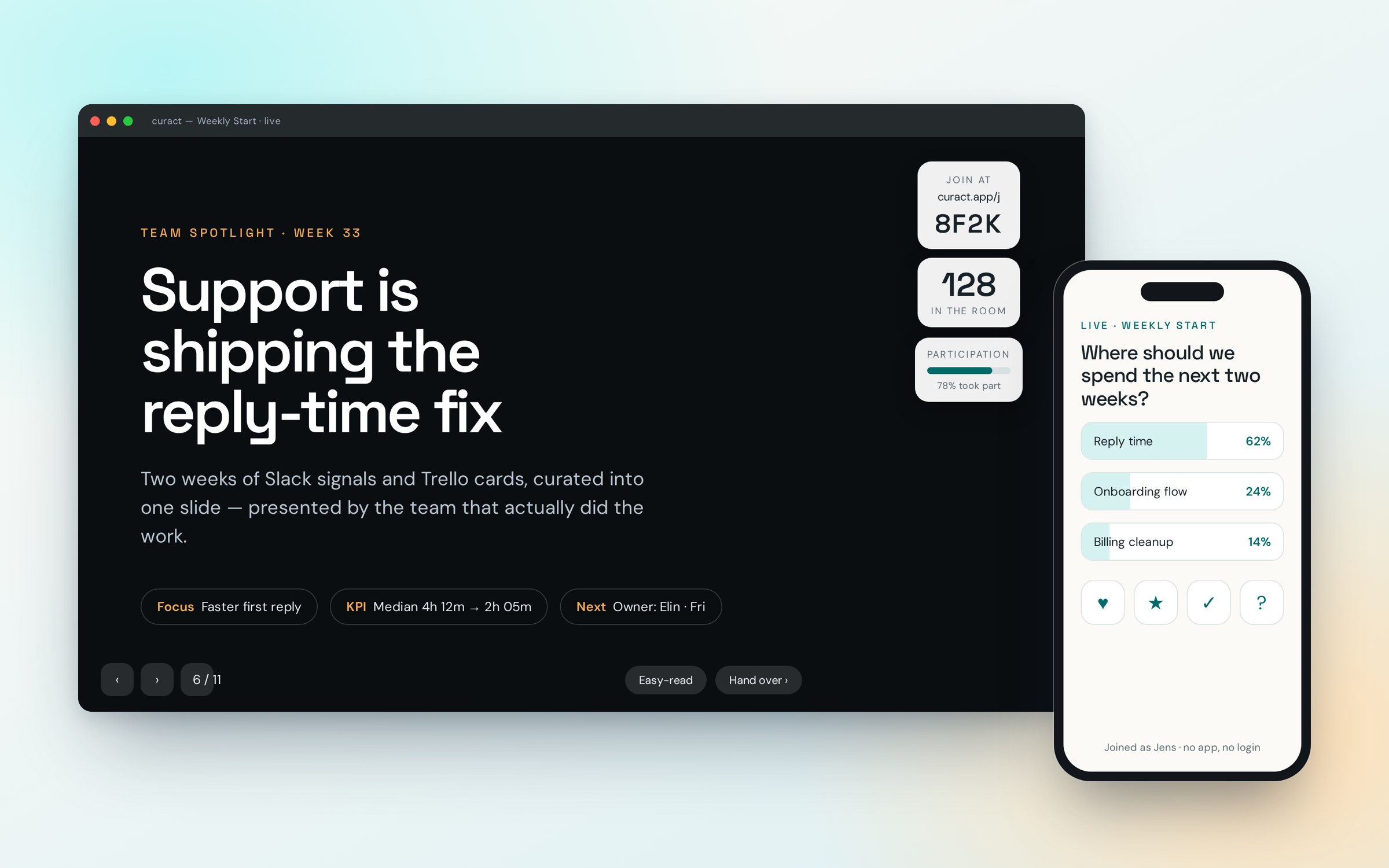
- 3Collect input asynchronously by Wednesday afternoon, using Curact to send automated contributor links into Slack so team leads submit metrics without manual reminder chains.
- 4Open the live session on Thursday with audience interaction, allowing attendees to join on their mobile phones to vote on discussion prompts before floor time ends.
How much time does structured meeting preparation save?
Structured asynchronous preparation replaces manual slide collection with automated collection windows that preserve focus time during the week.
Consider a hypothetical model of a company with 40 employees attending a 60-minute monthly update. In this calculation, direct attendance equals 40 person-hours per meeting, or 480 person-hours annually. If we assume a host spends 2 hours gathering slides across five department heads every month, that coordination work adds an assumed 24 hours per year.
Now model the workflow using automated slide submission. When contributor prompts are delivered automatically to department leads and reviewed in a unified host inbox in Curact, preparation review takes an assumed 10 minutes per meeting. Under these assumptions, annual host coordination time calculates to 2 hours instead of 24 hours.
Microsoft's 2023 Work Trend Index found that knowledge workers spend 57% of their time in communication software (meetings, email, and chat) and 43% creating content. Taken together, these figures suggest that reducing administrative coordination helps safeguard remaining focus time for deep work.
When should you not use a spotlight rotation?
Team spotlight rotations are ineffective for crisis management, rapid product launches, or early-stage startups with fewer than ten people.
During an operational emergency or a major commercial pivot, enforcing turn-taking distracts from critical priorities. Enforcing equal presentation time when an organisation must focus entirely on cash flow or product stability creates artificial friction.
Similarly, in small teams where every member works together daily, structured spotlights add unnecessary administrative overhead. The method provides value primarily when department growth creates functional silos.
How to keep quiet teams engaged after the spotlight ends
Engagement persists beyond a team's dedicated spotlight when follow-up items and metric updates are tracked continuously between quarterly cycles.
When Customer Support highlights a recurring bug during their quarterly fifteen minutes, the issue must convert into an owned follow-up task rather than vanishing when the session concludes. Tracking decisions across meeting series ensures quiet teams see tangible outcomes from their contributions.
On Monday, assign your next three meeting slots to teams that have not spoken this quarter, limit their input to three standard prompts, and automate slide collection. A quick trial of Curact shows how recurring templates and live phone participation make team spotlights simple to maintain.
Sources
- Work Trend Index: Will AI Fix Work? — Microsoft (2023)Most of the working day goes to communicating, not creating.
- The Surprising Science of Meetings — Oxford University Press / Steven G. Rogelberg (2019)Badly run meetings are a leadership skill problem, not a calendar problem.
Findings are paraphrased and linked to the publisher. No source text is reproduced.