
It is Thursday afternoon, and a message pops up in the team channel asking who took the action item from Tuesday's operational review. Two people remember discussing the customer onboarding delay, but neither marked it down as their task. The presentation slides were closed, the video link ended, and the conversation drifted into the week's general noise. By Friday, the decision has vanished, and the issue will reappear on next Tuesday's agenda in exactly the same state.
This quiet drop in momentum rarely happens because people lack discipline. It happens because most teams treat follow up after meetings as a separate administrative task to be written up hours later, rather than as an integral output of the meeting itself.
Why do decisions made in meetings disappear by Friday?
Decisions disappear after meetings because agreed outcomes are left as collective intentions rather than individual commitments. When a meeting host says 'we should update those documentation steps,' everyone in the call nods in agreement, but no single person takes explicit responsibility for writing the draft.
Our interpretation is that verbal consensus creates a false sense of completion. Because the problem was resolved conceptually in the room, participants feel the work is underway, even though no task was formally created.
This breakdown holds true for recurring operational calls, tactical syncs, and cross-functional reviews. It does not apply in the same way to exploratory brainstorming sessions or one-on-one personal coaching, where immediate task allocation is not the primary objective of the conversation.
How much does poor meeting follow up actually cost?
Poor meeting follow up inflates total meeting costs by forcing teams to spend subsequent calls re-litigating unassigned tasks. When work is dropped, the time spent discussing it in the original meeting is effectively lost.
In a 2024 survey of 5,000 knowledge workers across four continents, Atlassian found that respondents rated 72% of their meetings as ineffective. Meanwhile, Microsoft's 2023 Work Trend Index showed that workers spend roughly 57% of their working time in communication channels—including meetings, email, and chat— leaving 43% for creative execution. Taken together, these findings suggest that when communication fails to yield concrete execution, a substantial portion of the working week is spent coordinating work that never materialises.
To calculate the direct cost for your team, start with measurable figures. As a modelling assumption, consider a weekly six-person meeting lasting 45 minutes. The direct meeting time equals 4.5 hours of wage time every week.
Now apply a second modelling assumption: if the team spends an estimated 15 minutes per person each week asking for updates in chat or repeating context during the next call, that adds 1.5 modelled hours of secondary friction. Assuming 50 working weeks per year, that single recurring meeting consumes 225 direct hours and an estimated 75 modelled hours of follow-up friction per year.
How to structure meeting follow up that sticks on Monday
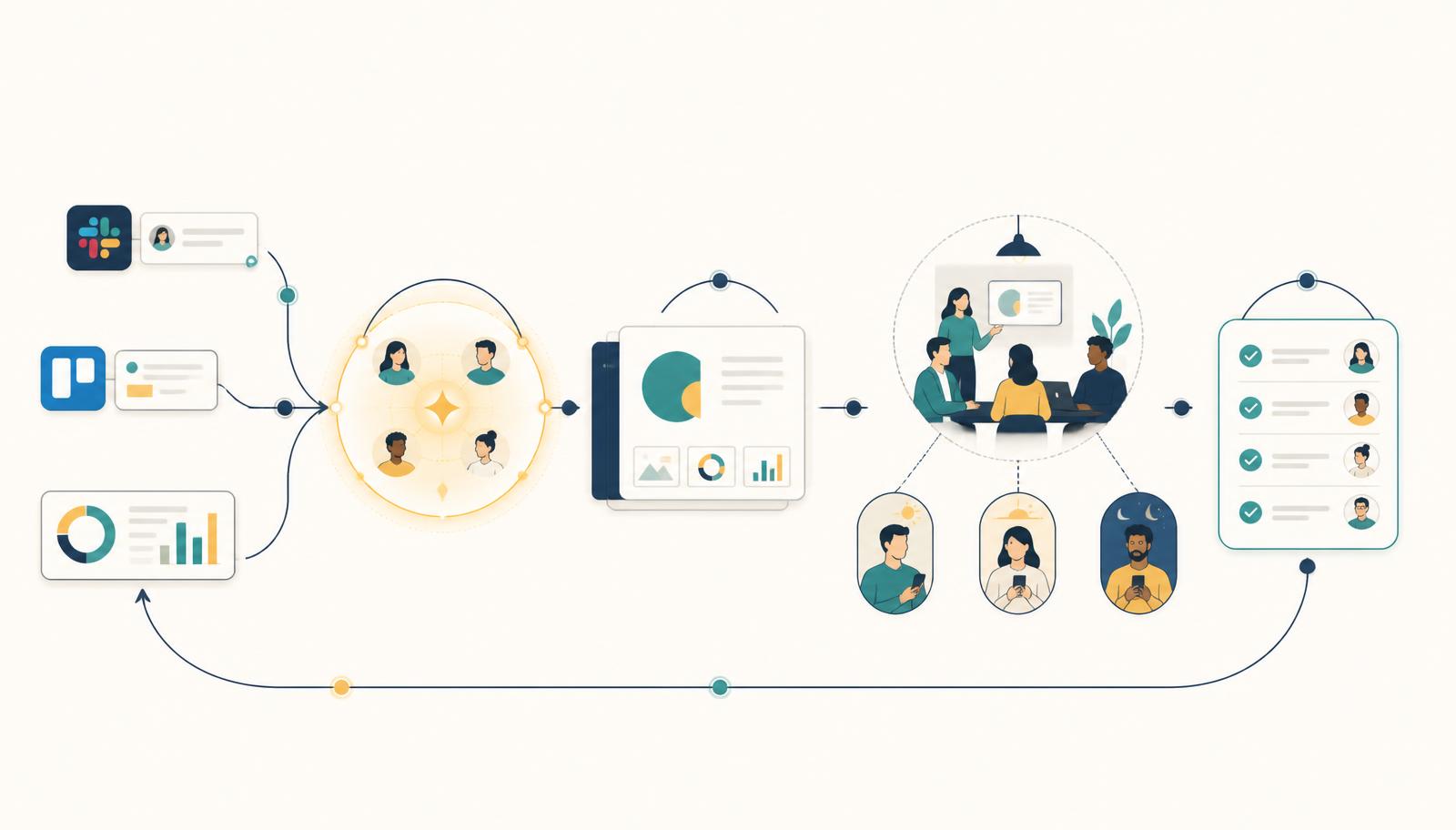
You can eliminate post-meeting ambiguity without adding administrative burden by establishing a simple run of show for the final five minutes of every operational call.
- 1Reserve the final five minutes of every agenda specifically for action assignment, regardless of whether the main discussion has finished.
- 2Review each proposed action item on screen and ask for a single named owner. If two people offer to co-own a task, choose one primary lead.
- 3Set an explicit deliverable date for every action item before anyone leaves the call. Avoid vague targets like 'end of week'.
- 4Publish the action list into your team's main communication channel within ten minutes of closing the call while context remains fresh.
- 5Review open action items from the previous meeting at the very start of the next call, spending no more than two minutes confirming completion.
How does Curact automate the transition from decision to action?
Curact prevents lost decisions by building action tracking directly into the live meeting interface. Rather than relying on a host to transcribe written notes after the call, participants record decisions and follow-ups on screen while the meeting is active.
When running a recurring meeting series in Curact, follow-up items are logged with a named owner and deadline during the call. These decisions automatically feed into the recap report generated immediately after the screen closes.
When the team gathers for the following week's meeting, the system pulls unresolved follow-up items directly into the preparation workflow. This ensures that past commitments are visible before the agenda is locked, keeping ownership clear from one week to the next.
How can you keep follow-up lightweight for small teams?
Keep follow-up lightweight by limiting the number of tracked actions to three critical items per meeting. Capturing every minor comment creates administrative noise that dilutes focus on major priorities.
For small operational teams, recording one clear commitment per core topic is more effective than maintaining a lengthy list of secondary suggestions. This guidance holds for routine status syncs, but does not apply to complex multi-stakeholder project handoffs or compliance reviews where every action item must be recorded for auditing. If an item does not warrant a named owner and a target date, it should remain an informal observation rather than an assigned follow-up.
Questions people ask
- Who should write the meeting follow-up recap?
- The person leading the specific agenda item should capture the action during the call. If one host runs the overall call, assign a designated note-taker before the meeting starts so the host can focus on facilitation.
- What should be included in a meeting follow-up message?
- A concise meeting follow-up message requires three elements: key decisions made, assigned action items with a single named owner each, and the agreed target completion date.
Sources
- Workplace Woes: Meetings Edition — Atlassian (2024)Knowledge workers judge most of their meetings to be ineffective.
- Work Trend Index: Will AI Fix Work? — Microsoft (2023)Most of the working day goes to communicating, not creating.
Findings are paraphrased and linked to the publisher. No source text is reproduced.